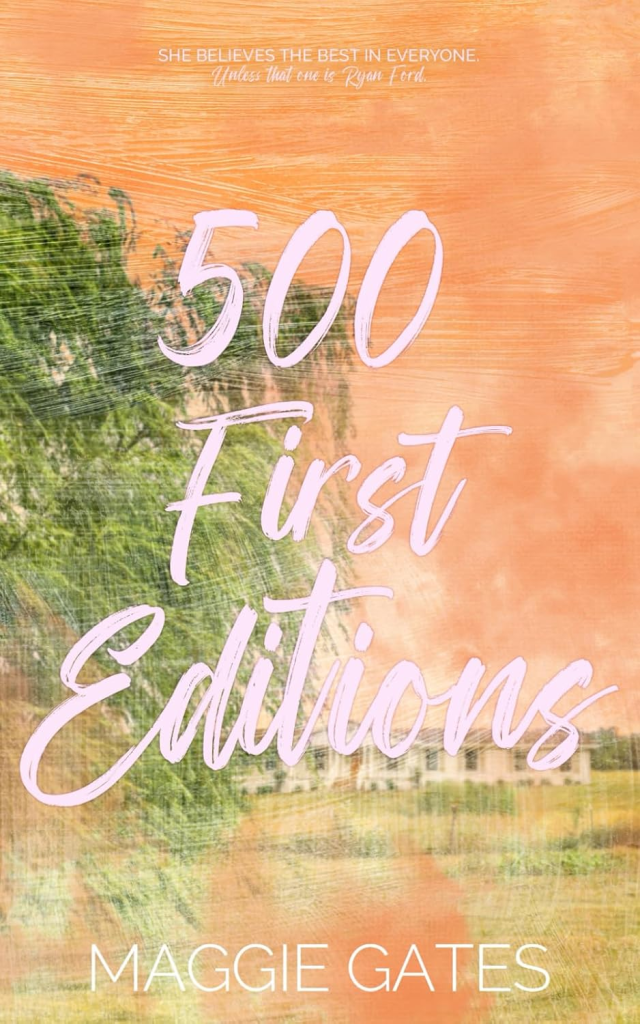
Romance author Willow Winslet believes the best in everyone, unless that one is Ryan Ford.
What’s worse than being the only single person in your friend group? A hot guy in the checkout line mocking your boring Friday night. But Ryan Ford isn’t just anyone. To Willow, he’s an intolerable dating coach, an obnoxious podcaster, and a life-coaching con artist. Seriously, who would buy a course that claims to make people fall in love?
Ryan Ford doesn’t believe in love at first sight, until he sets his sights on Willow Winslet.
Now, he’s ready to do whatever it takes to win Willow’s heart. There’s just one problem: she hates everything about him. But what’s a little obstacle like that in the grand scheme of things? Will she accept his public dare to give his dating program a shot? Or will she end their little game before it begins? He has three months to make her fall in love, and they’re playing for keeps. Let the games begin.
I knew this was going to be a five-star read the second I met Willow Winslet in chapter one (I mean, how can you not love someone bold enough to buy a drugstore vibrator on a Friday night), but somehow Maggie Gates kept making it better. This book starts like a hilarious rivals-to-lovers rom-com and slowly turns into something deeper, messier, and unexpectedly emotional.
In the beginning, Willow and Ryan are opposites in the most deliciously infuriating way. Willow is chaotic in the best “pink-haired romance author with a secret soft heart” sense. She’s quick-witted, mouthy, and so used to protecting herself that she uses banter like armor. If she keeps things playful, sarcastic, and a little abrasive, no one can get close enough to disappoint her.
Ryan, on the other hand, walks into every room with confident calm, like a man who knows exactly who he is and what he wants. At first glance, he feels like the typical “bro dating coach” who would sell motivational courses online, but then he opens his mouth and actually listens. He pays attention. He means what he teaches. His confidence isn’t ego; it’s conviction. He doesn’t want fans—he wants people to be loved well.
When they collide? Willow is ready to verbally tackle him, and Ryan is quietly fascinated. She thinks he’s a con artist with a catchy tagline. He thinks she’s brilliant and worth every second of patience. She believes he’s provoking her. He’s just trying to get close without scaring her away. Their dynamic is bickering meets magnetic curiosity, with an undercurrent of “don’t look at me too closely, I might actually like you.”
“Future husband, cupcake.”
“You don’t even know my real name.”
“Your first name is all I need. You can take my last name. Or if you’re feeling chatty, you can tell me your last name too, and I’ll take yours. I’m agreeable like that.”
And the wildest part? Long before Willow realizes she’s falling, she’s already letting Ryan in…which is exactly why, when a panel argument turns into a full-blown challenge, she ends up agreeing to be the test subject for his infamous “Ford Method.” Three months. One structured experiment to prove that connection isn’t luck; it’s choice. She swears she’ll never fall for him. He’s certain she already has more heart than she wants to admit. The bet is just their starting line—the feelings never cared about the rules.
Their banter in the beginning? Electric. Willow tries so hard to push him away, and he’s right there, steady and patient, letting her take up space without demanding anything in return. If The Ford Method was real, I’d buy the course, annotate every chapter, and probably cross-stitch the affirmations.
“Remember when I said it was a nice night to meet your future husband? I’m a man of my word, cupcake. Game on. But I’ll give you a peek at my playbook.”
Then life hits. Hard. When tragedy strikes barely a week into their “experiment,” their road trip to Kansas becomes a turning point—not just for their relationship, but for Willow’s entire understanding of family, love, and the truth she’s been trying to outrun. Ryan doesn’t swoop in to save her; he stands beside her while she saves herself. That mattered.
“I hug you because I feel indestructible when you rest your head on my chest, and I hope that makes you feel safe. I cup your cheeks because you always smile when I do, even if it’s just for a millisecond. It’s like holding the sun…and I kiss your lips so you know that I would give you my last breath if you asked for it.”
Once they settle into small-town Kansas, the entire tone of the story shifts—slower, more vulnerable, more intimate in ways that have nothing to do with spice and everything to do with being seen. Willow’s grief cracks her wide open, and instead of trying to “fix” her, Ryan becomes a quiet constant: running errands, ensuring she eats, letting her choose silence when words feel too heavy. He becomes the person who shows up for the little things—the late-night pierogis, the hot chocolate when dinner feels impossible, the grounding hand on her back when family tensions hit a nerve. There’s no grand gesture trying to win her over. He’s just there, learning her. Loving her in a way that never asks for credit. And that’s when you feel it: the Ford Method isn’t a gimmick. It’s patience. It’s kindness. It’s emotional honesty. It’s slow love that waits for someone to be ready.
“I’m scared of losing you. I feel like I’m barely holding on some days. So, if it feels like I’m holding you close, it’s because I can’t bear the thought of you not being here with me. I’ve spent my entire adult life helping people find their soulmates, but this is the first time I’ve felt anything close to the feeling they describe when I do.”
There’s a point in the story where all the emotions that Willow has been ignoring finally rise to the surface—her grief, her fear of being chosen, her complicated family history, her growing feelings for Ryan. It forces both of them to stop pretending they can glide through this “experiment” without consequences. Instead of running from the mess, they’re challenged to face it, to communicate honestly, and to choose each other with intention. The resolution doesn’t come from grand gestures, but from growth. It comes from two people learning how to love well, not just fall fast.
This book gave me all the nostalgic late-90s/early-2000s rom-com vibes, with a modern heart, a fierce girl gang, and a hero who actually communicates. It’s funny, heartfelt, swoony, and surprisingly cathartic. Saying goodbye to the WWs is bittersweet, but I cannot wait to see what Maggie dreams up next.
Romance fans, prepare to laugh, cry, snort-laugh, kick your feet, and then cry again. Willow and Ryan’s story isn’t just about falling in love—it’s about believing you deserve it.